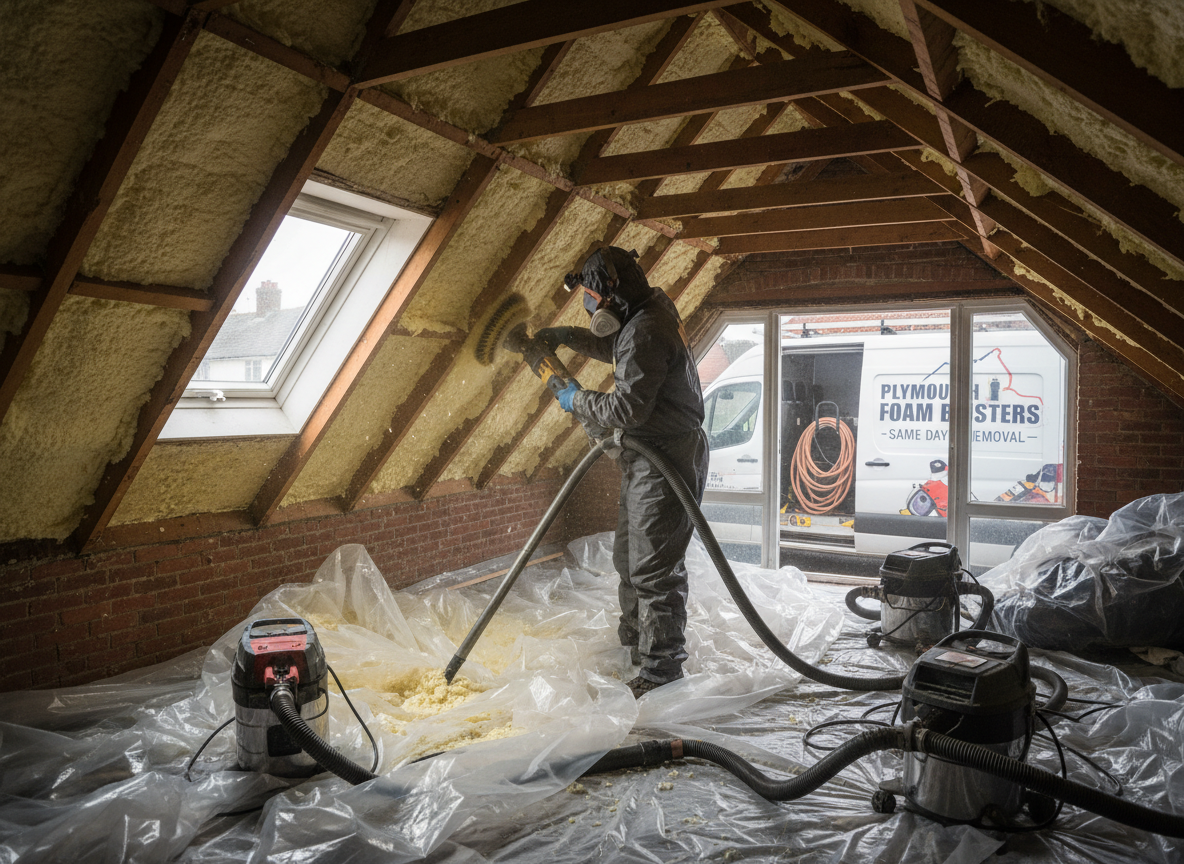
Plymouth's older terraced housing stock, particularly pre-war properties around the city centre and near the waterfront, often received spray foam insulation in lofts during earlier energy schemes. Removing it on the same day requires careful assessment of timber joists and roof voids where the foam has bonded tightly to rafters and can conceal damp from the region's frequent rainfall and salt-laden air. Technicians must contain dust and debris to prevent it settling into living spaces below, especially in narrow two-up two-down layouts common along streets off Mayflower Street.
The coastal climate in the Plymouth area accelerates moisture problems when spray foam remains in place too long. Once winter temperatures drop and condensation builds, the closed-cell material can trap water against slate roofs and stone walls, leading to rot that only becomes visible during removal. Same day jobs here frequently involve cutting access panels in ceilings of Victorian terraces to reach the full extent of the foam without disturbing electrical cables or pipework that run through those voids.
Disposal of removed polyurethane foam must follow local waste rules in Devon, with loads separated for licensed facilities rather than general landfill. In Plymouth properties the process also includes checking for residual isocyanates and ensuring ventilation is restored immediately after extraction to prevent lingering odours in small upstairs rooms typical of the local housing stock.
Technician insight
In Plymouth, the thing that catches most people out with same day Spray Foam Removal is how quickly coastal damp gets trapped behind the foam in 1930s stone terraces near the Hoe, turning a simple extraction into a moisture remediation job once the boards come up.
Loft Foam in Central Plymouth Terrace
Homeowner in a 1930s two-storey terrace off Union Street reported musty smells after heavy rain. Inspection showed spray foam sealing the entire roof void and holding moisture against the rafters. Same day removal cleared the foam, exposed the damp timbers, and restored ventilation so the space could dry before further repairs.
How it works
- 1
Initial Assessment
Inspect the loft or roof space to confirm spray foam extent and check for hidden damp or structural issues common in Plymouth terraces.
- 2
Site Protection
Seal off living areas with sheeting and negative pressure to contain dust during removal in compact Devon properties.
- 3
Foam Extraction
Cut and peel foam from rafters and joists, working around wiring and pipes typical in older Plymouth homes.
- 4
Cleanup and Ventilation
Remove debris, vacuum residues, and restore airflow to prevent moisture recurrence in the coastal climate.
Pricing
Cost depends on access difficulty and foam depth in Plymouth roof voids; upfront quotes provided before work starts.