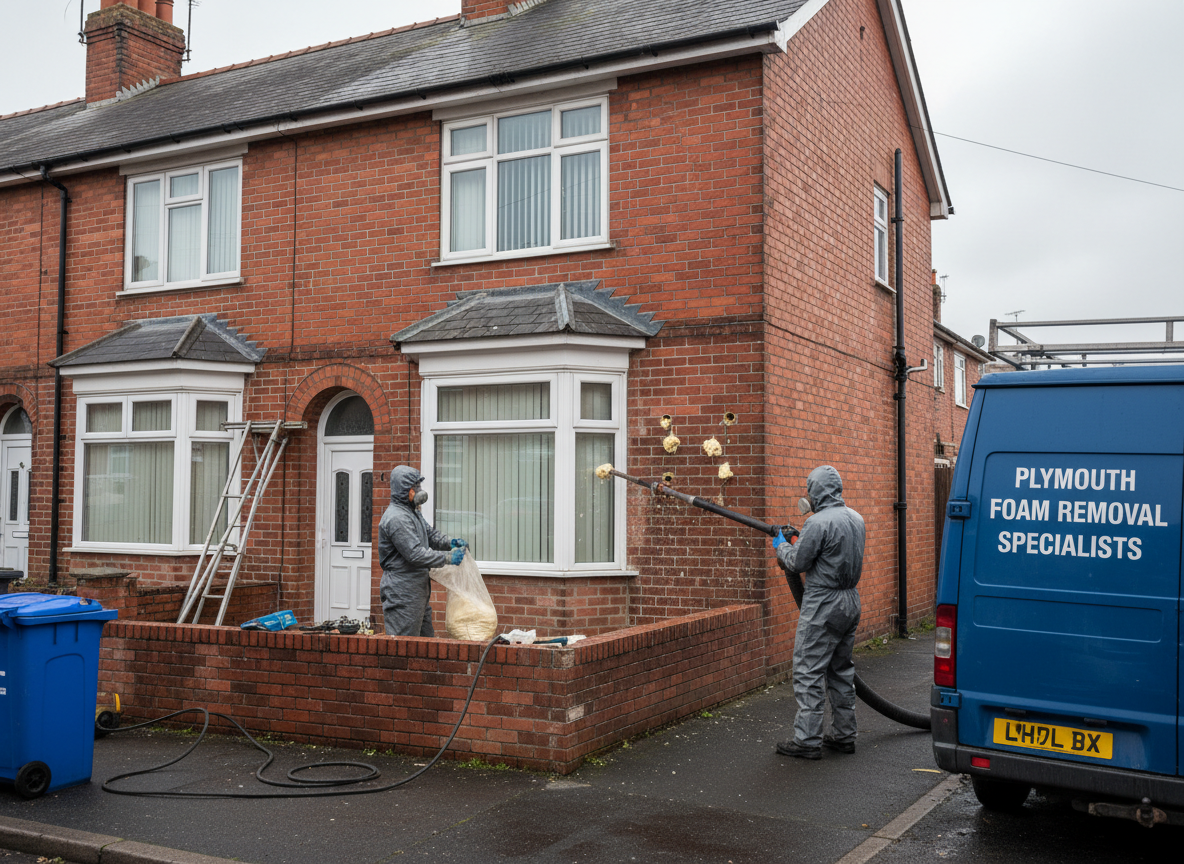
Plymouth's older brick and stone terraces, especially those built before the 1970s in areas like Mutley and the Barbican, often received cavity wall spray foam in the 1990s and early 2000s. Coastal weather brings frequent driving rain that saturates the outer leaf, and the closed-cell foam traps that moisture against the inner wall. Over time this leads to timber decay, plaster failure, and musty odours that homeowners first notice in ground-floor rooms. Removing the foam requires cutting access slots, mechanical extraction, and careful debris clearance without damaging the original brickwork or wall ties common in Devon stock.
The job changes with each property because cavity widths vary from 50 mm to over 100 mm and many walls contain rubble or mortar droppings that trap foam residue. In wet winters the material becomes heavy and sticky, slowing extraction and increasing the risk of water running down the cavity during removal. We always check for existing damp-proof course levels and any previous retrofit insulation that may have been added later. Homeowners in elevated spots near Plymouth Hoe or along the waterfront face extra wind-driven rain exposure, which means we often recommend additional ventilation slots once the foam is gone.
Edge cases include semi-detached houses where foam has migrated into party walls and Victorian properties where the cavity narrows at the base. We never leave loose foam fragments because they can block weep holes and create new damp bridges. After extraction the cavity is left clear so any remaining moisture can evaporate naturally before new insulation or repairs are considered. This approach respects the original construction details found throughout Plymouth and avoids the common mistake of simply covering over failed foam with new plasterboard.
Technician insight
In Plymouth, the thing that catches most people out with Cavity wall spray foam removal is how quickly coastal rain soaks the outer brickwork of pre-war terraces around North Road and Stoke; the foam then holds that water against the inner leaf, so what starts as a simple extraction often turns into a longer drying period once the material is gone.
Foam Removal in a Stoke Terrace
A homeowner in Stoke reported persistent damp on the ground floor. Inspection showed closed-cell foam blocking weep holes in a 1930s cavity wall. We extracted the foam through side access points, cleared debris, and fitted vents. The walls dried over the following weeks without further intervention.
How it works
- 1
Site Survey and Moisture Mapping
We inspect cavity access points, measure moisture levels in walls, and identify any rubble or debris that will affect extraction.
- 2
Targeted Access and Extraction
Small slots are cut at strategic heights; foam is removed mechanically while debris is collected to prevent blockage of weep holes.
- 3
Cavity Clearance and Ventilation
Remaining residue is vacuumed, walls are checked for damage, and temporary vents are fitted where needed to aid drying.
- 4
Final Inspection and Advice
We confirm the cavity is clear, document any timber or wall-tie issues, and provide guidance on next steps for the homeowner.
Pricing
Cost depends on property size, cavity condition, and access difficulty; we provide a clear written quote after the initial survey.